
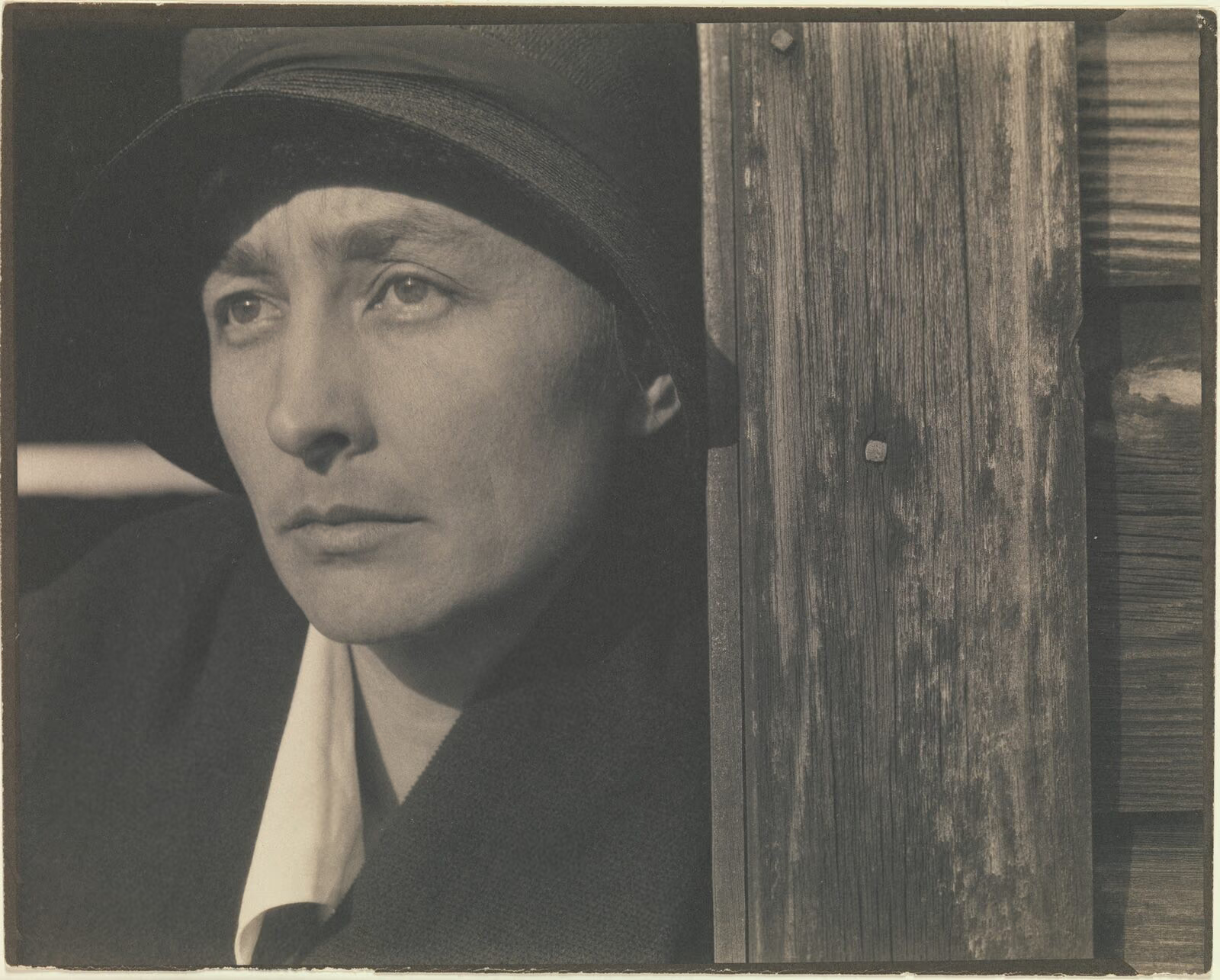

Painting
Georgia O'Keeffe
American painter of giant flowers, New York skyscrapers and New Mexico desert landscapes, whose career lasted seven decades.
Biography
Georgia O’Keeffe painted flowers so large they fill the whole canvas, as if seen through a magnifying glass. She made about two hundred of them, starting with Petunia, No. 2 in 1924.
It began with charcoal. In 1915, while teaching in South Carolina, she made a series of abstract drawings and posted them to her friend Anita Pollitzer in New York. Pollitzer took them to the photographer Alfred Stieglitz, who showed ten of them at his 291 gallery in 1916. O’Keeffe moved to New York in 1918 and married Stieglitz in 1924. From a 30th-floor apartment in the Shelton Hotel she also painted the city’s skyscrapers.
From 1929 she spent part of every year in New Mexico. She picked up bones and stones in the desert and put them in her paintings: Cow’s Skull: Red, White, and Blue (1931), Summer Days (1936). In 1946 she became the first woman to get a retrospective at the Museum of Modern Art. She settled in Abiquiú for good in 1949 and kept painting until 1972, when failing eyesight stopped her working in oils without help. She died in Santa Fe in 1986, aged 98.
Critics often read her flowers as sexual images. She rejected that reading many times, and she did not want to be called a “woman artist”, just an artist. Start with Jimson Weed/White Flower No. 1 (1932), a single white bloom. It sold for $44.4 million in 2014, at the time by far the highest price ever paid for a painting by a woman.
Go and see
- Petunia, No. 2
- Cow's Skull: Red, White, and Blue
- Jimson Weed/White Flower No. 1
- Summer Days