
Painting
Emily Carr
Canadian painter and writer of the Pacific coast, known for her British Columbia forests and First Nations totem poles.
Biography
Emily Carr was born in Victoria, British Columbia, in 1871, and spent most of her life there. She painted the wet coastal forests of the Pacific Northwest and the villages of the Indigenous peoples who live along that coast, including the Haida, Gitxsan and Tsimshian.
In 1910 she sailed for France with her sister Alice. After classes at the Académie Colarossi in Paris, she followed the painter Harry Phelan Gibb to the village of Crécy-en-Brie and then to Brittany, where she took up the bold colour and broad brushwork of the Fauves. Two of her paintings hung in the 1911 Salon d’Automne. Back in Canada the new style found few buyers, and for about fifteen years she barely painted, running a boarding house in Victoria to get by.
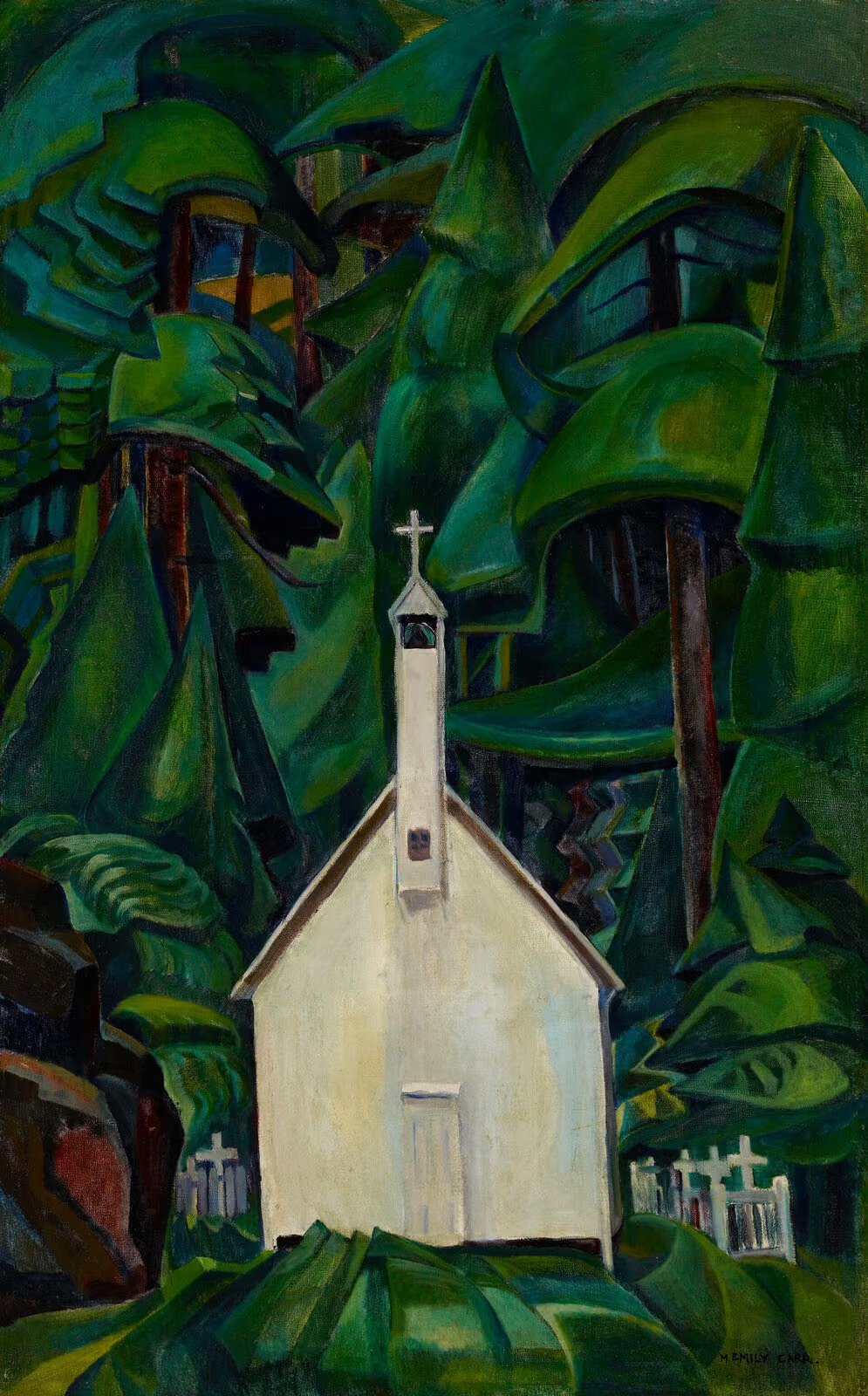
Things changed in 1927, when the National Gallery of Canada included her in an exhibition of West Coast art. There she met the Group of Seven, and Lawren Harris told her, “You are one of us.” Her most productive years followed: Indian Church (1929), Big Raven (1931), then forests painted ever more loosely. Late works such as Odds and Ends (1939) show the stumps left by industrial logging.
Heart attacks slowed her down, so she turned to writing. Klee Wyck (1941), titled with the name the Nuu-chah-nulth had given her, won the Governor General’s Award for non-fiction. She died in 1945. Look first at Indian Church: a small, upright white church at the foot of a dark forest made of almost geometric shapes.
Go and see
- Autumn in France
- Indian Church
- Big Raven
- Klee Wyck